






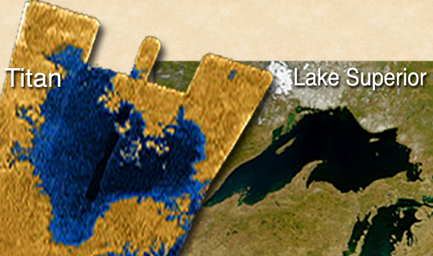
Titan's lake compared to Lake Superior
Source: NASA JPL
In keeping with the Space Elevator Journal's mission of showing what a post space elevator reality might look like I search out stories about resources in space that will be even more accessible and better researched after the space elevator is built.
"Instruments on NASA's Cassini spacecraft have found evidence [of] seas, likely filled with liquid methane or ethane, in the high northern latitudes of Saturn's moon Titan. One such feature is larger than any of the Great Lakes of North America and is about the same size as several seas on Earth."
Even after doing article after article on this I still get blown away by what's out there. The science fiction writer in me envisions convoys of robot tankers flying to Titan and filling up with fuel for a thirsty space community. Is it possible space elevator economics will make it profitable to return the fuel to Earth and we can stop draining our own planet?
I wonder how long it will be before there's a Dunkin' Donuts and a convenience store in orbit around Titan? "Thank you very much. Come again." --PB--
View Full News Release
"Source: NASA JPL - [These movies], comprised of several detailed images taken by Cassini's radar instrument, shows bodies of liquid near Titan's north pole. [They] show many of the features commonly associated with lakes on Earth, such as islands, bays, inlets and channels, are also present on this cold Saturnian moon. ... Strong evidence that larger bodies seen in infrared images are, in fact, seas [that] are most likely liquid methane and ethane."
View QuickTime Video (lg, no audio) (70.9 MB)
View QuickTime Video (sm, no audio) (56.1 MB)
Titan's lake compared to Lake Superior
Source: NASA JPL
Labels: Space commerce, space commercialisation, Space elevator, space habitat


Space food has come a long way since John Glenn choked down bite-sized cubes, freeze dried foods, and semi-liquids in aluminum toothpaste-type tubes to become the first human to eat a meal in space*. Hopefully, by the time the space elevator is built, there will be space farms and zero-gravity food preparation technology that better approximate eating on Earth (except for that floating thing).
A recent European Space Agency (Quicktime/WMP) video "gives an overview of the meals served on the ISS on normal days and at special occasions [and] also outlines the underlying nutritional and psychological factors that determine what astronauts [eat] in orbit."
These guys are eating "a Sicilian starter followed by roast quail in a wine sauce and rice pudding with dried fruit." It sounds better than my menu for today but, due to the stress of the small environment and work they do, food is the main source of relaxation and joy for International Space Station crew according to ESA astronaut Thomas Reiter who moderates a report about food for some experts on the ground in this video.
Oh, and the answer to the question posed in the headline? Velcro, baby, Velcro.
--PB--
*Yuri Gagarin did test food and water samples experimentally but his single-orbit flight did not require a meal.
Labels: Space commerce, space commercialisation, Space elevator, Space Food, space habitat
Space Exploration 2007 (SEC 2007) is the place for space elevator professionals, academics and enthusiasts to be Sunday, March 25 to Wednesday, March 28.
The program (in MS-Word format) for the Second International Conference and Exposition on Science, Engineering and Habitation in Space and the Second Biennial Space Elevator Workshop on the Space Engineering and Science Institute site includes three (out of a total of 8) keynote speakers on topics related to the space elevator.
Dr. Brad Edwards speaking on The Space Elevator: Problems, Progress, and Plans.
Dr. Bryan Laubscher gives a talk on the conceptual design of and benefits to mankind from the space elevator.
The history and current state of the Space Elevator Games will be covered by Ben Shelef of the Spaceward Foundation.
In another part of the program Dr. Laubscher returns to moderate a three-hour panel 'brainstorming session' in which the audience is welcome to participate entitled Global Space Elevator Road Map Workshop.
SEC2007, which is cosponsored by the American Society of Civil Engineers' Aerospace Division, is taking place in the Albuquerque Marriott Pyramid North Hotel in Albuquerque, New Mexico, USA.
Please mention you heard about the conference on the Space Elevator Journal when you either register for SEC2007 via the online registration form or mail in your payment and registration form to:
SES Institute
91 Mira Mesa
Rancho Santa Margarita, CA
92688
Labels: Space elevator, space habitat

The second Biennial Space Elevator Workshop takes place at Space Exploration 2007 (SEC 2007) - a four day conference on the theme of “Humankind in Space: Competition or Collaboration.”
According to conference organizers, The Space Engineering and Science Institute, SEC 2007, held Sunday, March 25 to Wednesday, 28 March 2007 in Albuquerque, New Mexico, USA, "will draw together an international array of scientists, engineers, educators, managers and entrepreneurs and students."

The conference offers keynote talks, planning sessions and panel discussions on a broad array of topics;
- planetary exploration,
- bases,
- habitation,
- space station,
- engineering and construction in space and on the Moon and Mars,
- space access,
- space transportation,
- space elevator technologies and advanced concepts,
- entrepreneurial ventures in/for space,
- space power,
- space resource development,
- NEO’s,
- space commerce, law, education
There will also be a Student Robotics Competition in the form of a space elevator (SE) climber challenge the goal of which is to design and build a climber able to climb a 30-foot ribbon with ground-based beamed power carrying a detachable payload representing SE cargo or, in the case of a moon-based SE, the command module components of a lunar base.
SEC 2007 is looking for multi-disciplinary student teams from high schools, two- and four-year colleges to participate and there are four already signed up;
- Intelligent Distributed Multi-Agent Robotics Systems Lab at the University of New Mexico
- Middle Tennessee State University, Murfreesboro, TN (headed by the SEC 2007 Robotics Chair Ahad Nasab)
- Department of Electrical and Computer Engineering at The University of Akron (Ohio)
- Department of Advanced Technical Education (ATE), Southwestern Indian Polytechnic Institute
Conference rates at the Albuquerque Marriott Pyramid North are available until February 14 by calling the hotel directly at (505) 821-3333 (Toll-free: 1-800-262-20430) or via the Marriot's online reservation system. Mention SEC 2007 or use Group Code 'spespea'.
Labels: space colonisation, Space commerce, Space elevator, space habitat, Space Law, space policy
Some people like art or cars. Techno-journalists are info-geeks who get excited about well-designed web sites engorged with hard information. Couple that with the desire to write about things that will happen after the space elevator is built like space tourism and solar-power satellites and the Space Future (SF) site is pure info-porn.
In a kind of logical mobius strip SF credits its own commercial consulting arm, Space Future Consulting with its genesis. In any case, it is the work of some well-ordered minds who have laid out a smörgåsbord of articles and studies about space habitat and tourism, space vehicles and space power generation.
Among those is the article mentioned in title from Spaceport Associates' Derek Webber laying out the principal parameters of a successful space tourism venture.
Webber posits that "the average potential orbital space tourist is probably male, aged mid fifties, and works full time even though being worth at least $200M" who will book his trip with a specialist space agency on a polar orbit that will provide the most diverse view of terrestrial features.
The article covers the potential medical, technical and human aspects of pre-flight, on-orbit and return phases of the journey.
Webber assumes orbit will be achieved by conventional rockets or space planes with no consideration given to a space elevator.
--PB--
Labels: Private space travel, space colonisation, Space commerce, space commercialisation, Space elevator, space habitat, space tourism
 Latest Space Elevator Headlines by Google News™